Astronaut Vocabulary in English for Kids
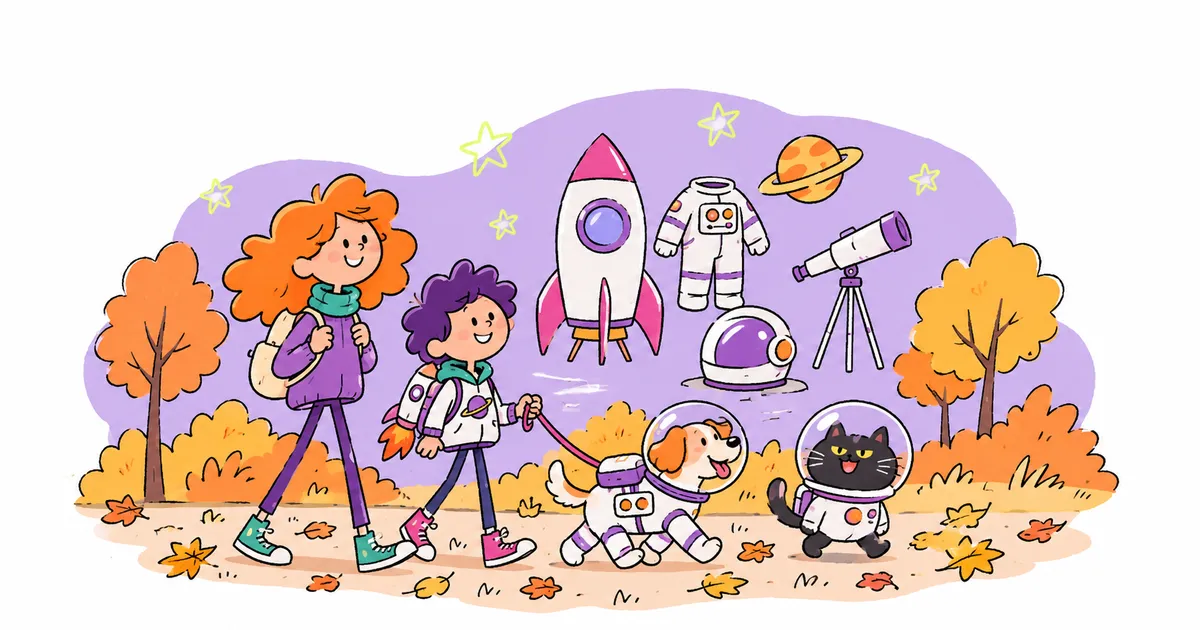
A 10-minute practice can teach 4–7 space terms through three steps: point, act, and speak. Astronaut Vocabulary in English for Kids: Words and Activities covers people, places, equipment, actions, and conditions in space travel. Start with visible objects, add short action phrases, then build a mission story. A beginner may say “capsule”; a confident learner can explain, “The crew is preparing to dock.” Linking each term to an image, action, and sentence creates three recall cues.
📥 Astronaut Vocabulary Mission Pack
Learn, use, and practise space mission words in English
Leave your email — we'll send the PDF to your inbox.No spam — the PDF plus one short reminder. Unsubscribe anytime.
Core Words and Phrases for a Space Mission
A lesson on Astronaut Vocabulary in English for Kids: Words and Activities should begin with concrete nouns and precise verbs. Teach one small group before adding more space words.
Astronaut
The astronaut floats.
🚀 Crew
The crew begins its mission.
🔤 Rocket
The rocket lifts off.
🔤 Capsule
The capsule lands safely.
🔤 Rover
The rover crosses a crater.
🔤 Spacesuit
The astronaut wears a spacesuit.
🔤 Orbit
The spacecraft orbits Earth.
Dock
The spacecraft can dock.
Show meaning before testing recall. A toy figure can be the astronaut, a cardboard tube the rocket, and a chair the capsule. Say the word, point to the object, and ask your child to copy the word or select the object. Beginners can participate before forming full sentences.
Combine the words into phrases: “put on a spacesuit,” “launch the rocket,” “orbit Earth,” “land on the Moon,” and “repair the rover.” Then use frames such as “The astronaut is ___” or “The crew needs ___.”
Using the Words in Context
For Astronaut Vocabulary in English for Kids: Words and Activities to become usable language, each term needs a specific situation. Instead of testing “helmet” alone, ask, “What does the astronaut put on?” Model: “The astronaut puts on a helmet.” Begin with short sentences and expand them as confidence grows.
A mission sequence creates repetition: “The crew enters the spacecraft. The rocket lifts off. The spacecraft orbits Earth. The astronauts dock with the space station. Later, the capsule lands safely.” Ask your child to order pictures or objects and retell the mission.
Use one stable sentence frame. Repeat “The astronaut needs ___” with a helmet, gloves, a spacesuit, and an oxygen tank before adding a new grammar pattern.
Older learners can add reasons and predictions: “The astronaut wears gloves because space equipment must be handled safely” or “The rover may find a large crater.” During the first retelling, prioritise meaning and correct one point at a time.
Activities for Different Ages
Astronaut Vocabulary in English for Kids: Words and Activities works when tasks match the learner’s age. Younger children need movement and visible objects. Older learners can classify terms, explain choices, and solve mission problems.
These levels are flexible. A nine-year-old new to English may need pointing and matching, while a younger multilingual child may be ready for full phrases. Choose tasks by language confidence, not age alone. LearnLink tutors adjust support while keeping the subject engaging.
Practice Ideas for Home Lessons
Short practice succeeds when words return in different forms. First, sort pictures into people, equipment, places, and actions. Next, hide one picture and ask, “What is missing?” Later, let your child instruct a toy astronaut.
Role-play creates a reason to speak. One person plays mission control; the other plays the astronaut. Mission control says, “Put on your helmet,” “Enter the capsule,” or “Repair the rover.” Switch roles so your child understands and gives instructions.
Mini Mission: Hear, Move, Say
Place a capsule, astronaut, helmet, and rover around the room. Say, “Take the astronaut to the capsule.” Your child completes the action, then describes it: “The astronaut is beside the capsule.”
Finish with retrieval, not another explanation. Put the materials away and ask your child to name a few words, complete two phrases, or describe one mission step. Revisit difficult words next time instead of repeating the full set.
Practice check
- Choose one small group of related words.
- Model each word with an object, picture, or action.
- Use every word in a short spoken phrase.
- Ask your child to retrieve words without looking.
- Repeat missed words in the next practice session.
Common Mistakes and Useful Corrections
Children may confuse an astronaut, who travels or works in space, with an astronomer, who studies space. They may also call every vehicle a rocket. A rocket provides launch thrust; spacecraft describes a vehicle made for space travel. Reinforce both distinctions with pictures.
Watch small grammar words too. We say “an astronaut,” “in space,” and “on the Moon.” An astronaut wears a spacesuit after they put it on. A launch vehicle can “lift off,” but a crew can “launch it.” Model the correction and invite repetition without interrupting play for a long grammar lesson.
Space-language myths
Myth: Children must spell every astronaut word before using it.
Fact: They can first recognise, say, and act out a word; spelling can follow.
Myth: All space terms are too technical for beginners.
Fact: Concrete words such as helmet, Moon, rover, and land are easy to show through objects and movement.
- Point to five astronaut pictures and name each object aloud together.
- Correct one mistaken word by modeling the right pronunciation, then repeat it twice.
- Sort eight word cards into people, equipment, places, and actions.
- Read a space picture book and identify three astronaut vocabulary words.
- Play charades using four verbs: launch, float, explore, and land.
When a word has several meanings or pronunciations, Cambridge Dictionary is a useful check before turning it into child-friendly examples.
Frequently Asked Questions
How Many Astronaut Words Should My Child Learn at Once?
Begin with a small group your child can practise repeatedly in one activity. Four to seven words may suit a beginner, but confidence and attention matter more than a fixed number. Use Astronaut Vocabulary in English for Kids: Words and Activities as a menu, not a test. Add terms after your child recognises most current words and uses some in phrases.
Should My Child Learn Space Facts and English Together?
Yes, when facts support the language. A crater picture explains crater; moving a toy around a ball demonstrates orbit. Keep the English goal focused. Your child does not need a detailed science lesson before using the words. Save facts requiring long explanations for another session.
What If My Child Already Knows These Words in Another Language?
Use existing knowledge as a bridge. Match the known idea with the English word, then practise an English phrase or sentence. Other languages are resources, not interference. A multilingual child may understand the concept immediately but still need practice with English sounds, articles, and word order.
How Can I Practise Astronaut Vocabulary Without Special Materials?
Use household objects, quick drawings, and movement. A chair can be a capsule, a bicycle helmet an astronaut helmet, and a paper tube a launch vehicle. Give instructions, arrange a mission sequence, or describe a toy astronaut’s actions. Progress comes from hearing, retrieving, and using words, not expensive equipment.
Try one 10-minute mission practice today:
- Choose 4–7 words and model each with an object or action.
- Use every word in one short mission sentence.
- Finish by asking your child to recall three words without looking.
A short one-to-one lesson can show what level and pace fit your child — book a trial English lesson.
Stay updated on our latest tips and resources by following us on Instagram LearnLink.